Problem Space 2 of 7 · Forensic reconstruction
Was erosion visible in the record before a failure, and from when?
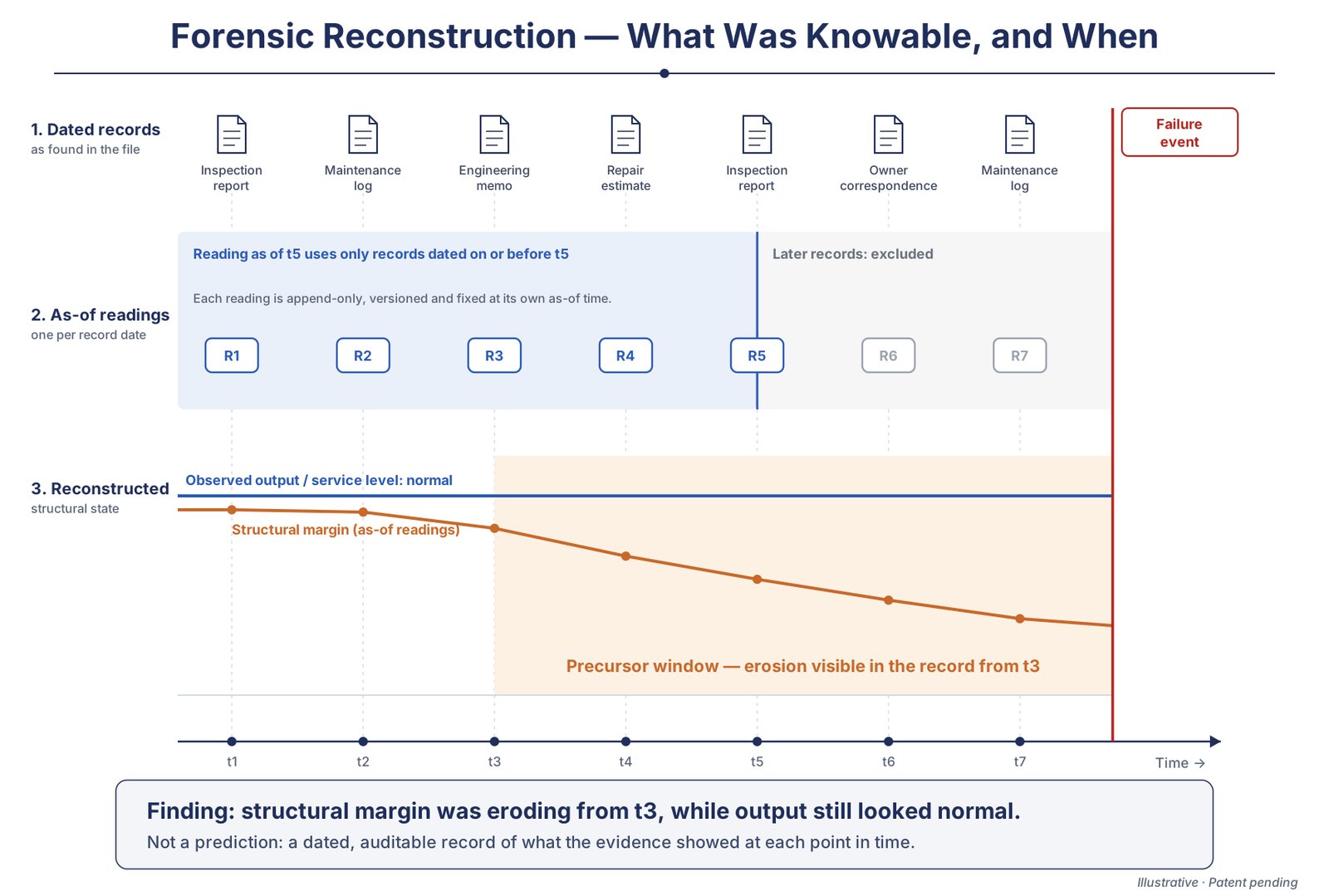
After an incident, the file holds dated records: inspection reports, maintenance logs, memos, correspondence. The instrument reads them in order and produces an as-of structural reading at each record date. Each reading uses only what was on record at that time, so the result shows when erosion first became visible in the evidence.
You'll recognize this if the question after an incident is not only what failed, but whether it could have been seen, and from when.
What you receive
A sequence of as-of readings, the date from which erosion is visible, and the boundary and records used for each.
Who uses it
Investigation boards and post-incident reviews, insurers on claims and recovery, counsel, boards and regulators.
What it starts from
The documents that already exist after an incident. No sensors or new installation required.
One Question Challenge
Can the answer to one question begin a transformation for your organization?
Bring us your version of this question. Submit one well-formed question about the relationships holding your system together. If the structural signal is present, you will know it; if not, the engagement stops. No data leaves your environment. No implementation required. No commitment beyond the question itself.
Take the ChallengeThe usual starting point is the One Question Challenge, or a bounded Structural Integrity Scan from existing records.
Figures are illustrative. SCFL-Quad is patent pending. Upstream Coherence Measurement Stratum (UCMS).